


Custom Wardrobe Ventilation: Prevent Mold on Cold Walls
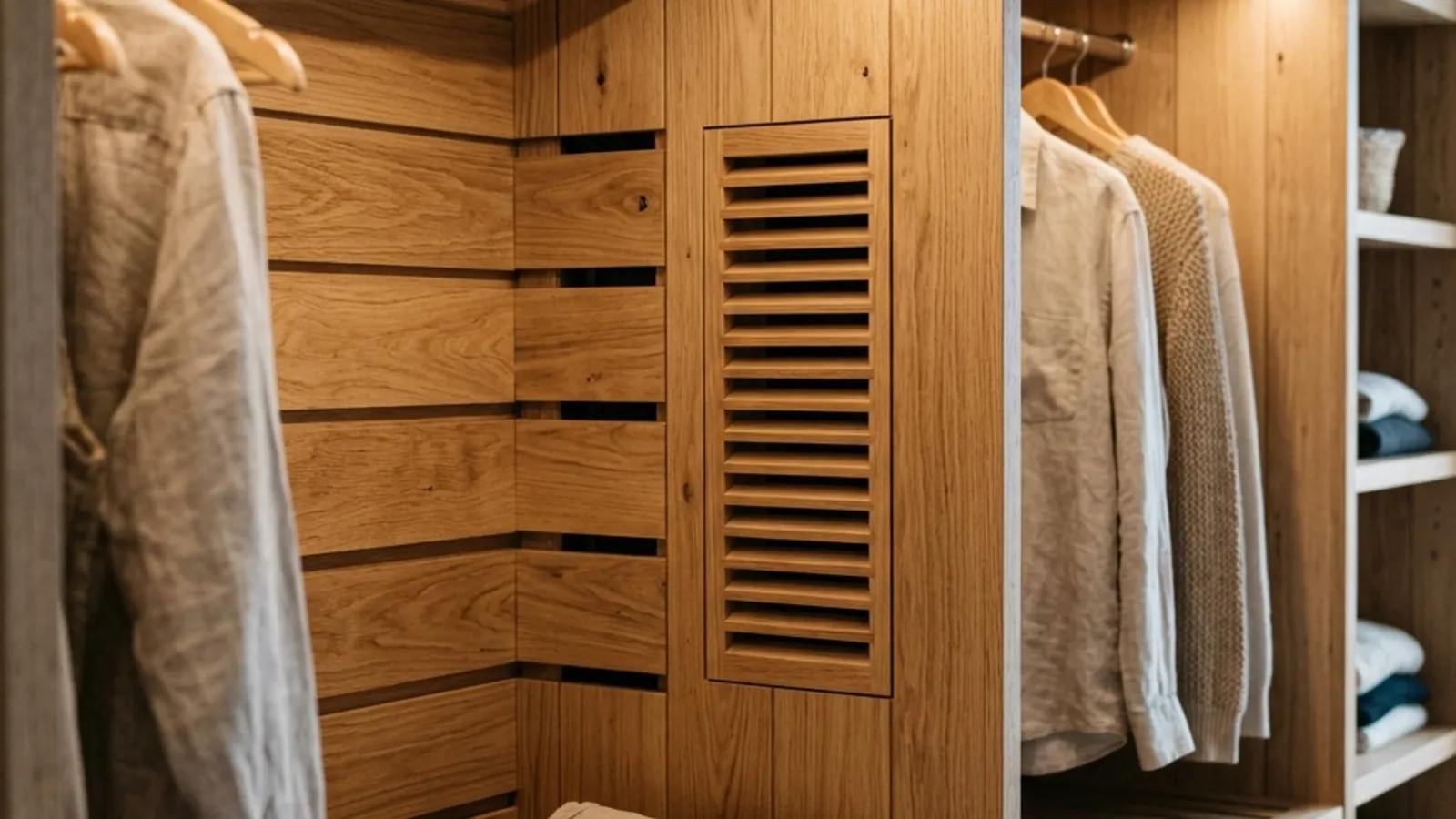
A beautifully designed custom wardrobe can quickly become a mold incubator if placed tightly against a cold exterior wall. Without deliberate ventilation pathways, trapped moisture condenses, ruining both your clothes and the joinery.
Avoid exterior cold walls if possible
The simplest way to prevent wardrobe mold is to plan your interior layout so that large, built-in wardrobes are placed against internal partition walls. If you must use an exterior wall—especially a north-facing one in a coastal stone house—you must implement active ventilation strategies.
Create a shadow gap at the top and sides
Do not scribe the wardrobe filler panels tightly against the ceiling and walls. Leave a deliberate shadow gap (at least 2-3 cm) around the perimeter. This allows air to circulate around the cabinet box, preventing cold pockets from forming in the corners.
Space the backboard away from the wall
Never push the backboard directly against the plaster. Ensure the cabinet design includes a structural void of at least 3-5 cm between the wall and the back of the wardrobe. This continuous air gap is crucial for allowing any moisture on the cold wall to evaporate.
Install plinth vents for air intake
Air needs a way to enter the void behind the wardrobe. Install discreet ventilation grilles in the bottom plinth (sokl). As the room air warms up, it will rise behind the wardrobe and exit through the top shadow gap, creating a continuous, passive convection loop.
Consider passive vents inside the cabinet
If the wardrobe stores damp coats or shoes, consider installing small passive vents in the internal shelves or backboard to allow moisture to escape into the rear ventilated void. For expert help coordinating your interior design with building physics, contact us.
Interior Design in Croatia
Coastal interiors designed from the floor plan outward
Explore Interior Design in Croatia