


Preventing Rising Damp at the Slab-to-Wall Junction in Croatia
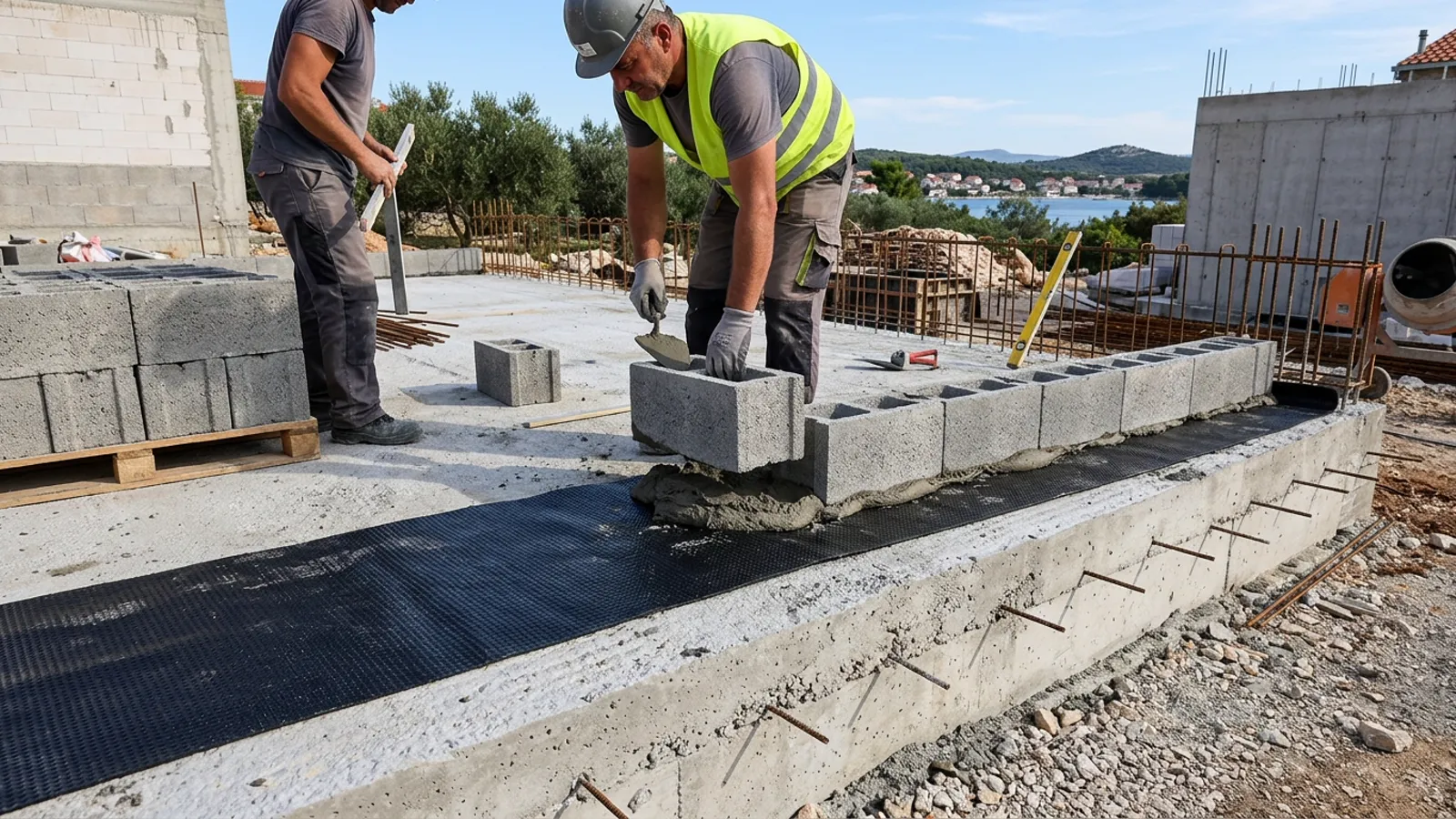
Rising damp is one of the most destructive forces in house construction. By installing a robust bituminous damp-proof course over the concrete slab directly under the first course of masonry walls, you permanently block moisture from traveling upward into your living space.
Check 1 – Surface Preparation
Before the membrane is laid, the concrete slab must be clean, dry, and free of sharp protrusions. A quick sweep is not enough. Any sharp stone or piece of debris left on the slab can puncture the damp-proof course under the immense weight of the wall, creating a path for water.
Check 2 – Correct Membrane Selection
Standard thin plastic sheeting is insufficient. You must use a heavy-duty, reinforced bituminous or specialized polymeric damp-proof course (DPC). The membrane must be strong enough to withstand the compression of the brickwork without tearing or extruding over time.
Check 3 – Proper Overlaps
The damp-proof course must overlap by at least 15 to 20 centimeters at every joint. These overlaps should ideally be sealed. If the rolls are simply butted together, moisture will easily find the microscopic gap and travel up the wall.
Check 4 – Seamless Connection to Floor Waterproofing
The DPC under the walls must eventually connect perfectly to the waterproofing membrane laid across the rest of the floor slab. Ensure there is enough overhang (usually 10-15 cm) extending past the wall so the floor waterproofing can be torched or glued directly onto it, creating a continuous tub.
Check 5 – Mortar Protection
When laying the first bed of mortar on top of the membrane, care must be taken not to slice the membrane with the trowel. A protective layer of mortar is laid, and the first course of blocks is set perfectly level. To ensure your new house construction avoids damp issues, contact our expert team.
House Construction in Croatia
Planning, coordination and execution control for new houses and villas
Explore House Construction in Croatia