


Apartment renovation in Croatia: check underfloor heating screed before laying floors
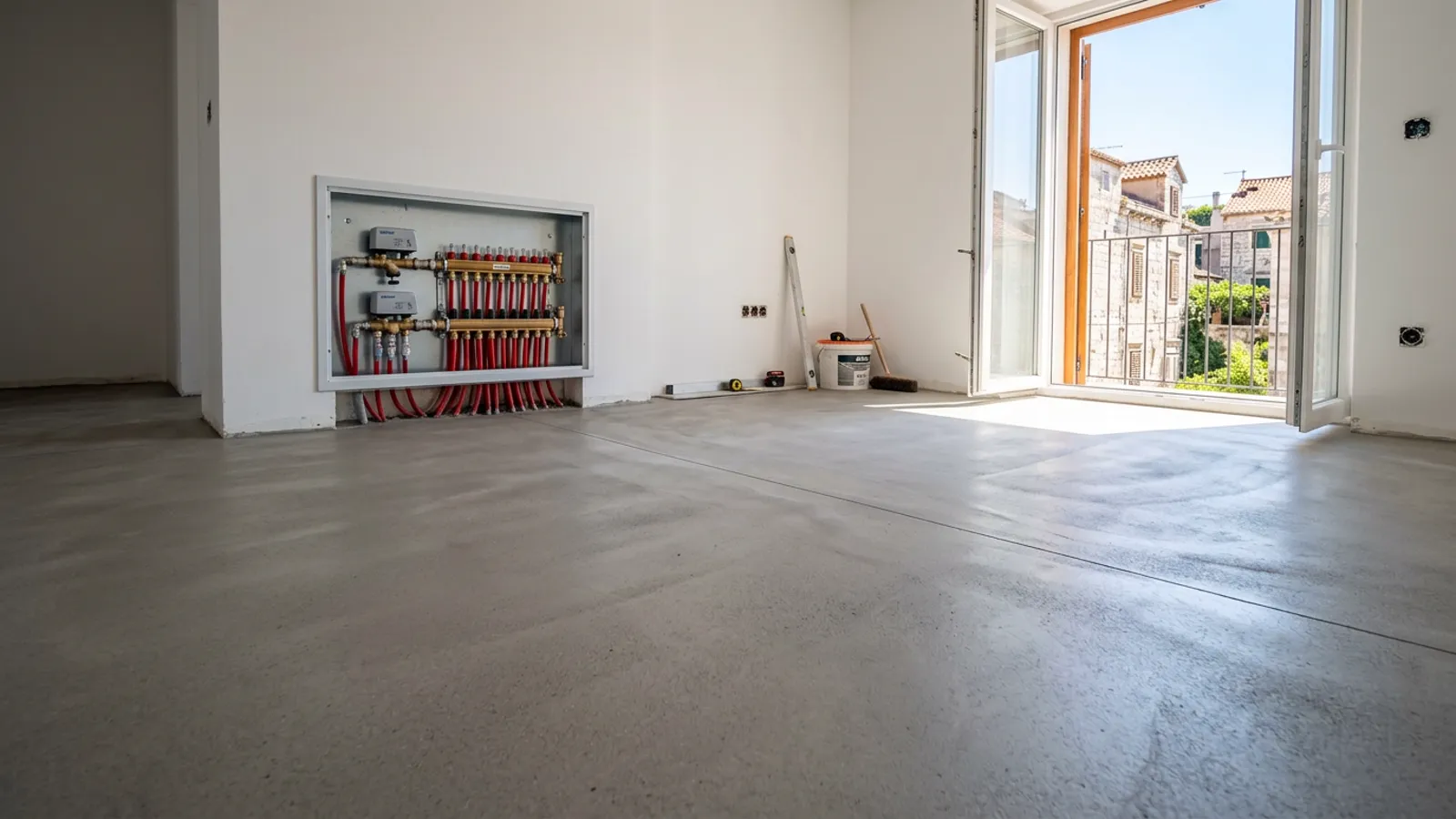
Laying parquet or large-format tiles over underfloor heating requires a flawless screed. Verifying curing times, expansion joints and moisture levels before the flooring goes down prevents cracked tiles and lifted parquet later.
Confirm the heating protocol is complete
Before any floor covering is laid, the screed must go through a strict heating protocol. This process gradually increases and decreases the temperature over several weeks to release stress and residual moisture. Skipping this step during an apartment renovation often leads to cracking later.
Check moisture levels before laying parquet
Even after curing, the screed must be tested for moisture, typically using the CM (Carbide Method) test. For parquet over underfloor heating, the moisture limit is extremely strict (usually under 1.8% for cement screed). Never let the installer guess the moisture level based on time alone.
Verify expansion joint placement
Heated screeds expand and contract. Expansion joints must be correctly placed at doorways, between different heating zones, and across large rooms. If these joints are bridged by rigid tiles without proper uncoupling, the tiles will eventually crack.
Ensure compatibility of leveling compounds
If the screed requires self-leveling compound before laying LVT or thin tiles, the compound must be explicitly rated for underfloor heating. Using standard filler will cause it to delaminate and turn to dust under the thermal stress.
Inspect the surface for strength and cleanliness
The screed surface must be hard, free of dust, and without loose top layers. A scratch test can confirm its strength. If the surface is friable, it must be mechanically sanded and primed before any adhesive is applied. For help coordinating these critical phases, contact our experts.
Apartment Renovation in Croatia
Complete apartment renovation with one responsible partner
Explore Apartment Renovation in Croatia